
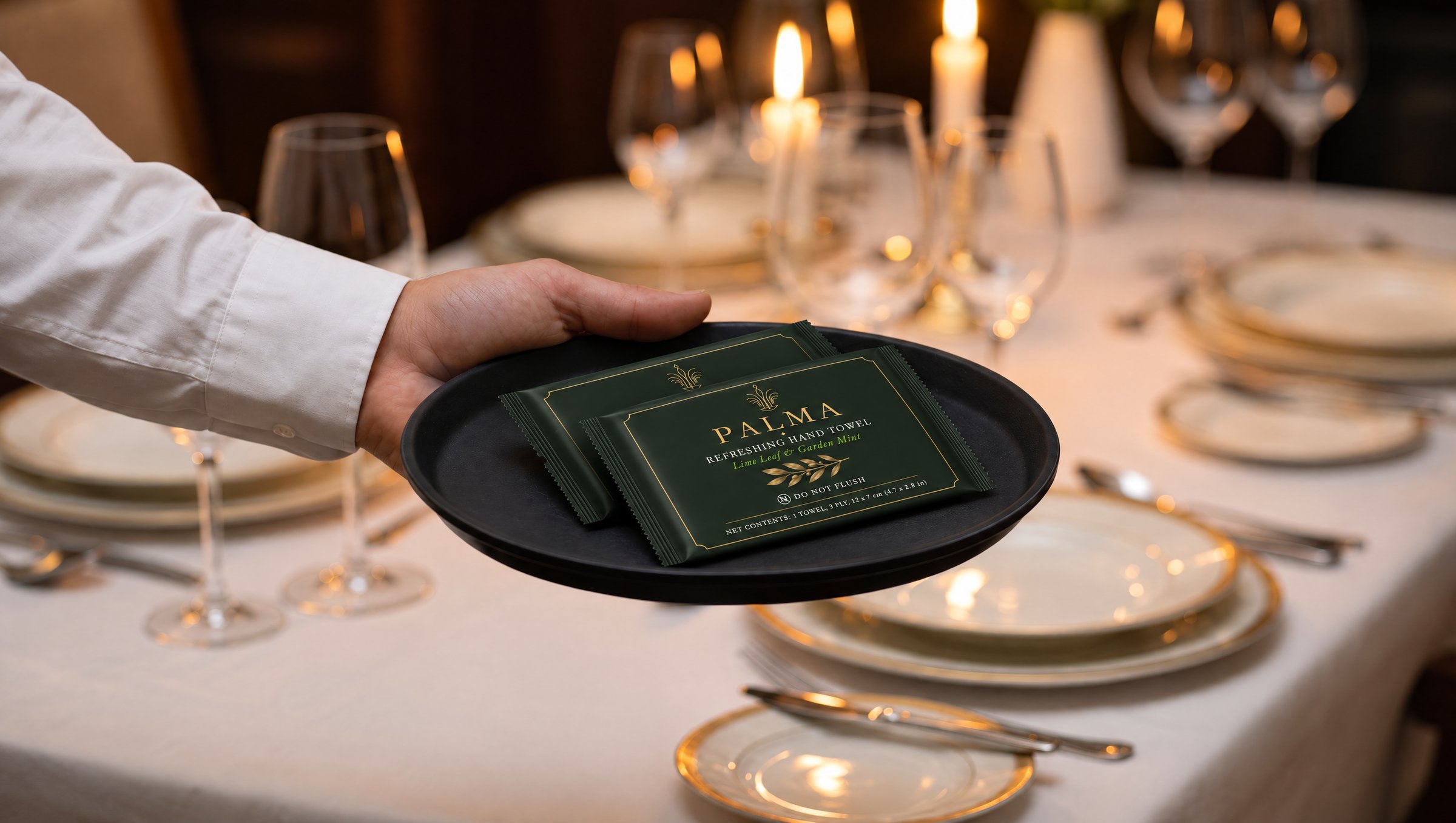
Few gestures in hospitality are as small and as complete as the refreshing towel. It arrives at the edge of a meal, cool to the touch and quietly fragrant. It asks nothing of the guest except a moment of attention. Done well, it feels inevitable, as if the room had been planning it all along. Done carelessly, it becomes an afterthought on a crowded table. Whether you run a twelve seat counter or a two hundred room hotel, the same rules apply. This guide covers the whole discipline: where the ritual comes from, why it works, how to run it on a busy floor, and what to ask of any supplier you trust with it.
What refreshing towel service is
Refreshing towel service is the practice of offering guests a lightly scented hand towel at a deliberate moment in the meal or the stay. In restaurants it most often appears after hands on courses such as shellfish, barbecue, or omakase, and again at the close of the evening. In hotels it appears at arrival, in the spa, at turndown, or beside the pool. Airlines and premium lounges have long used it to mark a change of pace. The format we recommend is the individually sealed towel, served chilled or at room temperature. It needs no warmer, no steamer, and no laundry, and it reaches every guest in the same condition on the busiest night of the year. What does not vary is the principle. The towel is a pause made physical, a signal that the guest is being looked after between the larger beats of service.
Where it comes from
Two traditions meet in the modern ritual. In Japan, oshibori is the custom of offering a rolled, damp towel to guests on arrival and through the meal: welcome and respect expressed through an object rather than a speech. In Türkiye, a host pours a splash of lemon kolonya into a guest's cupped hands after the meal, and the citrus brightness becomes the last thing the evening leaves behind. PALMA grew from the second tradition and is made in Türkiye to this day. Both customs share one idea. A small, repeated gesture of refreshment, offered the same way to every guest, says more about a house than any speech at the door. The closer your version stays to that origin, the more natural it feels on the floor.
Why the gesture works
Psychologists describe a pattern often called the peak end rule: guests judge an experience largely by its most intense moment and by how it ended, not by an average of every minute. A refreshing towel placed at the close of a meal lands on that ending, which is why so small an object is remembered so far out of proportion to its cost. There is also a simpler, physical explanation. A cool towel and a composed fragrance wake the senses after a long meal without demanding attention. The brief contrast makes the moment register in a way a spoken goodbye never quite manages. The guest is given one final, tactile confirmation that the evening was considered from beginning to end.
Guests do not remember the towel itself. They remember the feeling of being thought of at the exact moment they expected to be forgotten.
The PALMA Standard
How to run the service well
The ritual survives a busy Saturday only if it is simple enough to repeat without thought. These are the steps that hold up in real service:
- Choose the moment deliberately: after hands on courses, before dessert, or at the close. One moment, decided in advance, always the same.
- Decide the temperature and hold it: chilled from a dedicated tray in the refrigerator, or at room temperature. Never heat the sealed sachets or place them in a towel warmer.
- Present on a small tray or vessel that belongs beside your tableware, offered from the guest's right or according to your house standard.
- Speak one quiet sentence at most. The towel explains itself; a longer script turns a gesture into a performance.
- Clear promptly. A used towel and its sachet should never linger beside the guest through the next course.
- Assign ownership. One person per section holds the ritual each shift, so it never falls to whoever happens to be nearest.
- Keep the fragrance consistent night after night, so the gesture reads as the character of the house rather than the choice of a supplier.
In hotels the same steps apply across a wider stage. Arrival towels ask for speed, because a traveler's patience is shortest at the front desk; spa and pool towels ask for a cool, fresh hand; turndown asks for near silence. Decide the moment and the temperature for each touchpoint separately, write them down, and brief them the way you brief any other standard. What gets written down gets repeated.
The mistakes that undo it
Most failures of towel service are failures of drift. The chilled tray is left out through a long service and the towels reach the table tepid. Fragrance creeps louder as a well meaning team adds scent, until the towel competes with the meal instead of refreshing after it. Timing wanders: the towel arrives mid conversation, or after the bill, when the evening is already over. Presentation frays when the tray is swapped for whatever plate is free. And the ritual collapses entirely on the night it is needed most, because stock ran short and no one owned the reorder. Each mistake is small. Together they teach the guest that the gesture was decoration, and decoration is the one thing a closing ritual cannot afford to be.
One further mistake deserves its own sentence: offering the towel only on special occasions. A gesture that appears for holidays and tasting menus but vanishes on an ordinary Tuesday teaches guests that your care is conditional. The ritual earns its meaning through repetition. Whatever standard you set, hold it for every cover, every night.
What to look for in a supplier
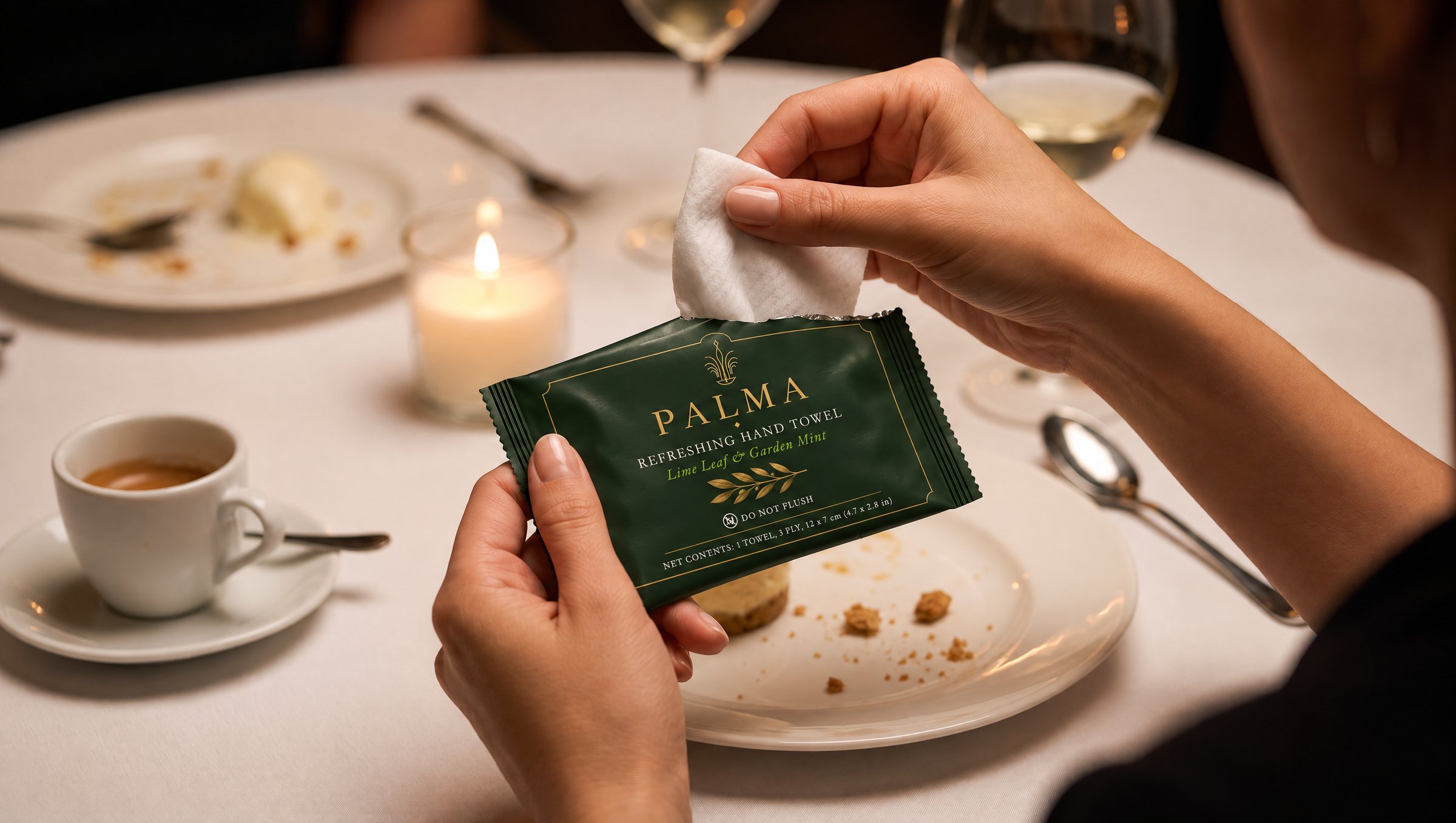
A supplier is not selling you towels; they are taking responsibility for one of your most visible gestures. Judge them accordingly. Fragrance should be composed, consistent from batch to batch, and quiet enough to support food rather than compete with it. The sachet should tear open cleanly in one motion, because the guest will do it themselves at the table. The towel should feel soft and substantial in the hand. Ask for the full ingredient list and read it; it should be printed on every sachet. Operationally, look for reliable lead times, a reorder process your manager can run in minutes, and service guidance beyond the product itself. Before you commit, ask for a working evaluation: samples run through real services, with your team's fatigue and your guests' reactions as the measure. This is the standard we hold ourselves to at PALMA, and it is a fair standard to hold anyone to.
The reward for getting all of this right is quiet but compounding. Regulars come to expect the towel the way they expect the bread; first time guests mention it without quite knowing why it stayed with them. A small ritual, run with discipline, becomes part of the identity of the room. That is the entire case for refreshing towel service: not novelty, but the steady, repeated proof that your care extends all the way to the goodbye.