
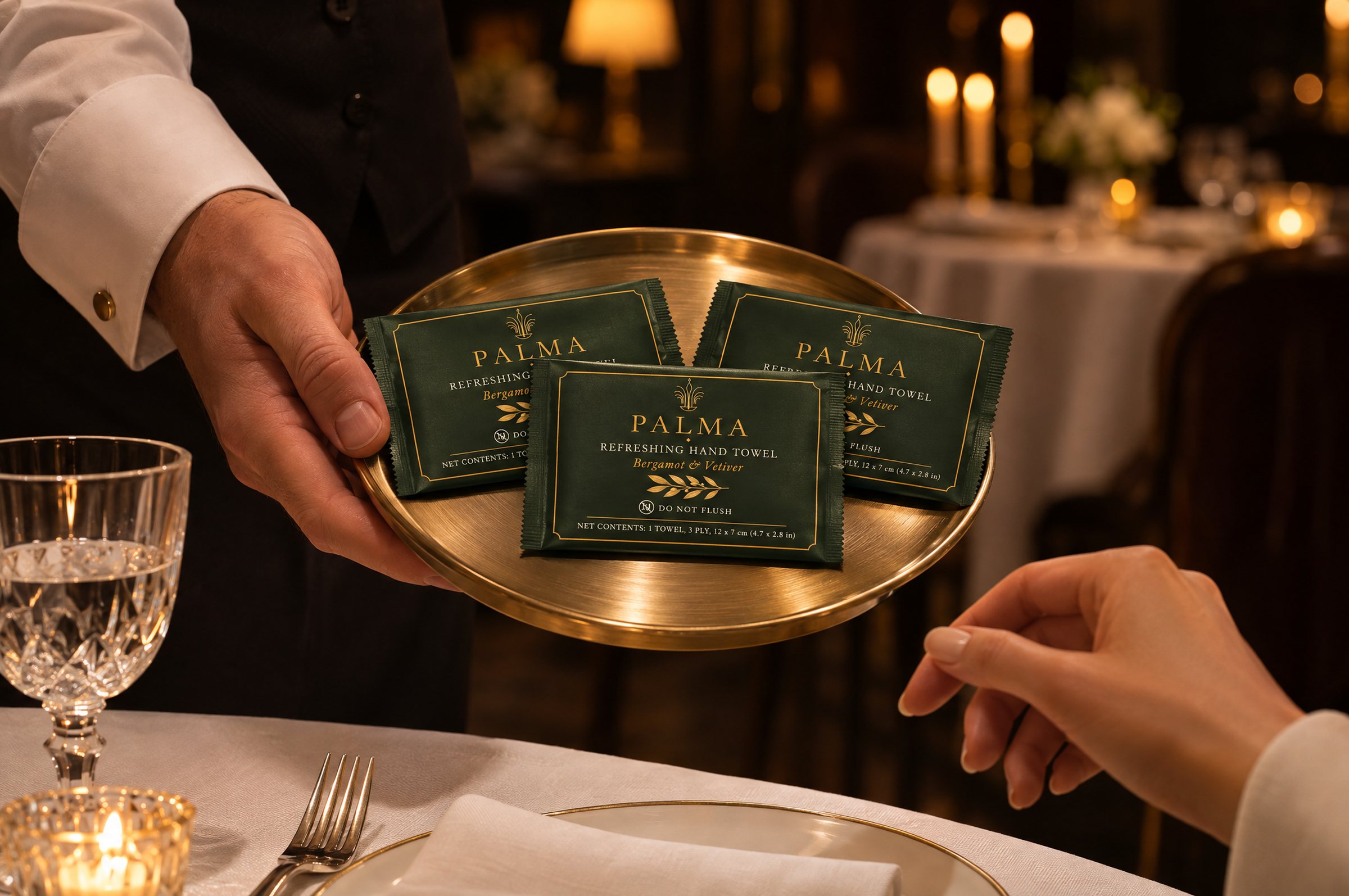
Operational ease is part of luxury. The guest never sees it, but the partner feels it every time. Behind every composed dining room sits a back office that either hums or strains, and the difference reaches the table in ways no one can quite name. When supplies arrive without drama and reorders take minutes instead of phone calls, the whole room settles into its work, and that calm is served, course by course, to every guest who walks through the door. Luxury, in other words, is an operations problem before it is a design problem.
The invisible half of service quality
A restaurant is only as calm as the operations that feed it. Service quality is usually discussed in terms of training and choreography and tone, but every one of those things depends on supplies arriving as promised. The towel that runs out on a Saturday, the fragrance substituted without warning, the parcel that misses the delivery window: guests never learn why a detail vanished. A missing amenity is never announced; it is simply absent, and absence is the loudest thing in a quiet room. Guests register that the space feels slightly less finished than it did last time, and they are right. A team cannot deliver a ritual it does not have. The most elegant service script in the world fails quietly when the storeroom is empty, and no amount of front-of-house grace can compensate for a back office in quiet chaos. This is why an amenity partner should be chosen with the same care given to a fishmonger or a wine merchant. The best partners understand that they are not selling a product so much as underwriting a ritual, night after night, without applause. Procurement, done well or badly, is hospitality by other means.
The hidden cost of friction is rarely measured in money alone. It is the manager on the phone at four in the afternoon, chasing a shipment while the dining room is being set. It is the order form that asks for information already given three times, the invoice that does not match the quote, the login that expires on the morning of a full house. It is the over-ordering that ties up cash on a shelf because lead times cannot be trusted, and the under-ordering that forces a team to ration a gesture that was supposed to feel generous. Friction also compounds in less visible ways. A ritual that is difficult to maintain is quietly dropped, first on busy nights, then altogether, and a detail that once distinguished the room disappears without anyone deciding it should. Multiply one clumsy reorder process across every vendor a restaurant manages, and the back office becomes a second job. There is also the quiet resentment that builds in a team asked to compensate for someone else's disorganization, a cost that never appears on an invoice but shows up in turnover and in the tone of a pre-service briefing. Each small friction taxes attention, and attention is the scarcest resource in any service room. Whatever a supplier makes difficult is, in the end, made difficult for the guest.
The guest never sees the reorder. They see what the reorder made possible, or what it quietly took away.
PALMA operations note
What a good reorder flow should feel like
- A clear record of what was ordered last, in the quantities actually used
- Reordering in minutes, from a phone or a desk, without re-entering details already given
- Transparent stock and lead times, so planning replaces guessing
- One consistent point of contact when a situation needs a human
- Resources close at hand: service guides, fragrance notes, presentation standards
- Predictable delivery that respects the rhythm of the service week, not the shipper's convenience
How PALMA approaches it
This is the reasoning behind the PALMA partner portal we are building. Today a reorder is one email or one call. In time, partners will sign in to a dashboard that holds the practical center of the relationship. From there they will review their order history, place a reorder without rebuilding it from memory, and browse a resources section containing service guides, fragrance documentation, and presentation standards. Order history stays visible, so planning the next quarter takes an afternoon rather than an audit, and reorders begin from the last confirmed quantities, ready to be adjusted, so routine replenishment is a review rather than a reconstruction. Private label projects have their own dedicated space, so a custom program can be tracked without mixing into routine replenishment, and support remains close at hand when a question needs a person rather than a page. New relationships typically begin with an evaluation kit, so the product is judged in the room before it is ever ordered at scale. The intent is that a manager can handle the entire supply relationship in the quiet half hour before doors open, and then think about it no further for the rest of the week. None of this is glamorous, and that is precisely the point. It is deliberately unremarkable software: no gamification, no noise, nothing that exists to be admired in a screenshot. The measure of it is how seldom a partner has to think about it at all. The portal exists so the operational side of the partnership takes as little attention as possible, leaving more of it for the people at the tables. Operational ease is not separate from luxury. It is where luxury is either kept or lost, one quiet transaction at a time.